The Chair Experiment: Why Your Audience Needs More Than One Angle
In the early 1900s, British philosopher Bertrand Russell shared a thought experiment that still resonates today. It wasn’t about marketing, branding, or social media. But it holds a powerful lesson for anyone trying to get their message seen online.
The experiment starts with something simple: a chair.
Imagine twenty people standing in a circle, each looking at the same chair from a different spot.
One person sees the chair from the front.
Another notices only the side.
A tall person sees the top.
A child sees the legs from below.
All of them are looking at the same object—but what they see depends entirely on their perspective.
Here’s the catch: none of them are wrong. Each perspective is accurate, but none of them show the chair in its entirety.
This is Russell’s point: our perception is always limited by perspective. We rarely experience reality as it is. Instead, we experience reality through the lens of our viewpoint.
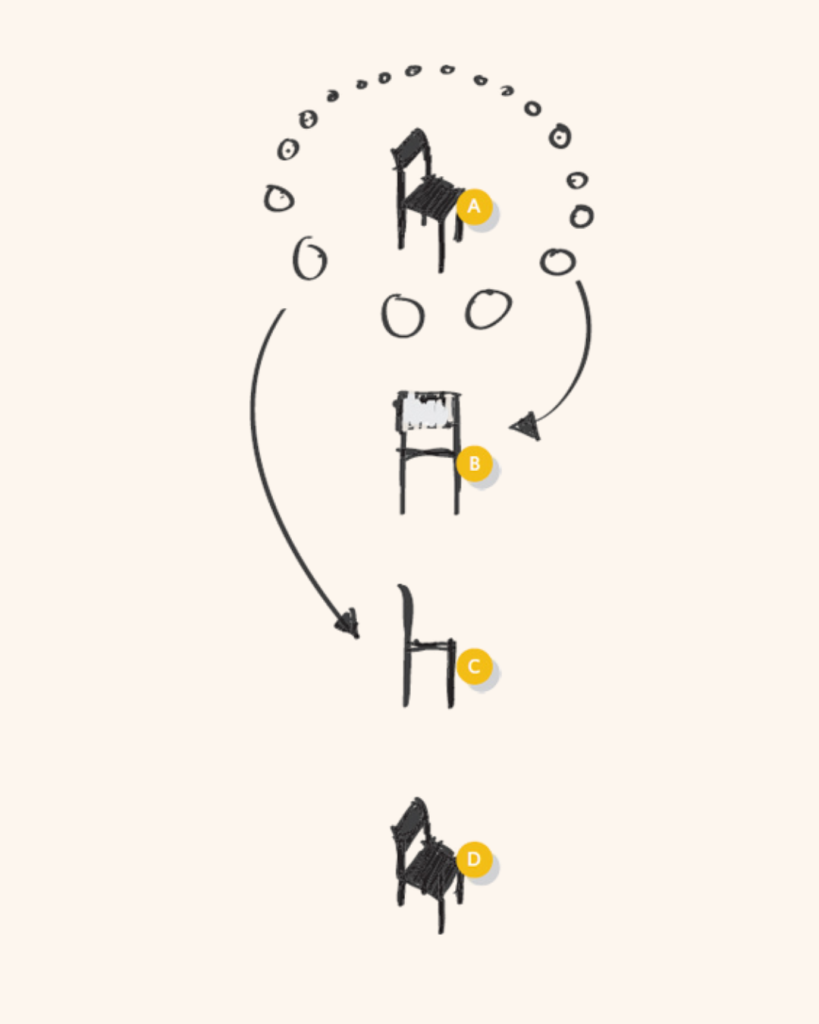
And while the chair itself may be a single reality, the experience of it changes dramatically depending on where you stand.
What a Chair Can Teach Us About Content Strategy
So why should business owners, coaches, and creators care about a 100-year-old philosophy thought experiment?
Because your content and messaging work the same way.
When you share your message online—through LinkedIn posts, Instagram reels, or an email—you’re showing your audience one angle of the chair.
But your audience doesn’t all stand in the same spot.
- Some of them are new to your world and only see a sliver of what you do.
- Some are seasoned experts who recognize part of your message but miss the nuance.
- Others may misunderstand your intent completely—not because you’re unclear, but because they’re looking from the wrong side.
If you only ever show one angle, many people will never grasp the full picture. They may walk away thinking they “don’t get it,” when really they just haven’t seen the message from the perspective that clicks for them.
The Visibility Gap: Why Great Content Gets Overlooked
This is the visibility gap most entrepreneurs face.
It’s not that you don’t have valuable ideas.
It’s not that you’re not talented enough.
It’s that your audience hasn’t seen your message from the angle that makes it land.
Here’s what happens when you don’t shift perspectives:
- Content feels invisible.
You’re posting, but people scroll past because it doesn’t click with where they are. - You repeat yourself—but without impact.
Saying the same thing the same way creates noise, not recognition. - Opportunities pass you by.
Potential clients don’t “see themselves” in your message, so they assume it’s not for them.
The good news? Just like you can walk around the circle to see the chair from multiple sides, you can shift your content angles to help your audience see your message more clearly.
CTRL + ALT + Reframe™
This is exactly why I created the CTRL + ALT + Reframe™ method—a framework designed to help you make your message visible from every perspective.
Here’s how it works:
- CTRL (Control): Anchor everything in your core message. This is your “chair.” It doesn’t change. It’s the through-line your audience should recognize no matter what angle you present.
- ALT (Alternate): Shift into alternate angles. This might look like:
- Teaching your concept directly (step-by-step).
- Telling a personal story that illustrates the idea.
- Offering a hot take or myth-busting approach.
- Using an analogy or cultural reference that makes it stick.
- Reframe: Add context that makes the message meaningful to them. Stories, analogies, client wins, or behind-the-scenes moments reframe the core message in ways your audience can connect with.
The message stays the same.
The perspective changes.
And suddenly, people “get it.”
Why Shifting Angles Builds Recognition
Think about the strongest brands in the world.
Nike doesn’t just say Just Do It once.
They show it through athletes, through ads, through culture. Different angles, same core message.
Apple doesn’t just say Think Different once.
They reframe it through design, innovation, and storytelling.
The repetition doesn’t make them boring—it makes them recognizable.
Your content can work the same way. By shifting perspectives, you give your audience more chances to see the whole picture, until your message becomes unforgettable.
Practical Ways to Apply the Chair Experiment to Your Content
So how do you take this philosophical experiment and turn it into a content strategy?
Here are some practical steps:
- Identify your “chair.”
What’s the one core message you want to be known for? The big idea you can repeat endlessly without it getting old? - List at least 5 alternate angles.
Write your message as:- A teaching post (practical how-to).
- A story (personal or client-based).
- A myth-buster (what people get wrong).
- A hot take (contrarian perspective).
- An analogy (using culture, history, or everyday life).
- Create a rotation.
Instead of creating brand-new content from scratch, rotate these angles. Each week, highlight a different perspective of the same core message. - Watch what lands.
Pay attention to which angle clicks with your audience. That’s not a cue to abandon the others—it’s a sign that you’ve found the viewpoint they needed. - Reframe for depth.
Add context—your story, your clients, your cultural lens. This transforms your message from abstract to personal.
The Ripple Effect: From Invisible to Memorable
When you only post from one perspective, you’re like the person shouting “It’s a chair!” from the front row while half the circle just sees a flat line of wood.
But when you shift your content angles, you invite your audience to walk around with you. You help them see the backrest, the legs, the seat, the whole thing.
And once they see it clearly, they don’t forget it.
They can repeat it.
They can share it.
They can spread your message for you.
That’s how you build visibility. Not by shouting louder, but by showing the same truth from multiple perspectives until it becomes undeniable.
It’s Not More Content
You don’t need more content.
You need more angles.
Your job isn’t to reinvent yourself every week—it’s to reveal the same message from different viewpoints, until your audience sees the whole picture.
That’s the power of Russell’s chair experiment.
That’s the power of CTRL + ALT + Reframe™.